Episode Transcript
[00:00:06] Speaker A: Welcome to the Leadership window podcast with Dr. Patrick Jenks. Each week through a social sector lens, Patrick interviews leaders and experts and puts us in touch with trends and tips for leading effectively. Patrick is a board certified executive coach, a member of the Forbes Coaches Council, a best selling author, award winning photographer and a professional speaker.
And now, here's Dr. Patrick Jenks.
[00:00:31] Speaker B: Welcome to episode 153 everyone. Hope everyone is doing fine. It is early June and I'm in Columbia, South Carolina, which one of its famous to claim is its heat and they call it famously hot. Columbia, South Carolina and I woke up to 54 degrees this morning.
Actually I had to turn on my porch heater for just a few minutes. So I'm enjoying that. Warm days, cool mornings. I don't know how long it's going to last, but I'm going to try to take advantage of it.
For those of you who think you've had a tough day and you think you have a hard job, I'm going to start this show with a snippet from the book written by today's guests.
So here we go.
It it's hard enough to hang on to a jet at 1000 mph with static electricity arcing through the cockpit while threading thunderstorms with 4,000 pounds of explosives strapped to your wings or going blind on our leader while pulling nine GS to maneuver into a position of advantage in an air combat mission, simultaneously trying to get eyes on the bandit and the lead. And in a three dimensional virtual fishbowl, it's hard enough to fly in a disciplined formation while working the radar, managing a data link, listening to radio calls and monitoring the stream of data on the display that come at us both in the aircraft and the helmet.
It's harder still in combat when you're tracking multiple targets, coordinating with other air assets, or dodging through an integrated air defense system bristling with surface to air missiles and you're avoiding getting shot down.
Now I ask you, how was your day?
What does your world look like? How would you describe in your leadership world that same kind of dimension of what makes it difficult for you? People talk about the hardest job in the world, rocket science or brain surgery or fighter piloting.
Maybe it's, maybe it's leading an organization, trying to create social change in the community.
Maybe that's the hardest job in the world.
Whatever it is, we all have our things that want to distract us, our things that challenge us.
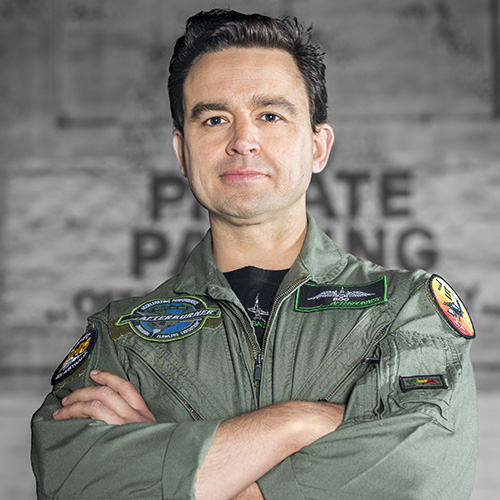
And we're talking today with Christian Boo Boucouses.
He is a former fighter pilot turned entrepreneur, keynote speaker and leadership expert.
Boo, as his friends call him, and I'm sure that was on, on the side of his airplane as well. Boo served as an FA18 Hornet pilot in the Royal Australian Air Force and he has translated his experience in high stakes aviation to successful ventures in the business world. He's the CEO of Afterburner Incorporated, and that's a company that has helped thousands of organizations implement what he calls the flawless execution model, or flex, to achieve their goals.
Boo's leadership has guided Afterburner in transforming businesses worldwide, including NFL teams like the New York Giants, who his team really kind of helped win the super bowl back in the day. We won't say too much about that because they happen to beat the Patriots to do it, which doesn't matter to me, but it matters to my son. So I don't know if I want him to listen to this episode. In any case, Boo, as his friends call him, is our guest today and man, I just can't, I can't be more excited about this. Just talking about how, how someone who, in that really high stakes environment views some of the stuff we talk about on a daily basis. So, Boo, let me say thank you for carving out time for us and sharing coming in and sharing some insights with us on the show. Welcome.
[00:04:45] Speaker A: It's a pleasure. And you've got a little bit of fighter pilot in you there, Patrick as well, because Jinx is actually a, a maneuver that autopilots perform. It's the last ditch. Just before you're about to die, you try and jink the airplane out of the, out of the gun sight of the bad guy.
[00:05:01] Speaker B: That sounds about right. The last maneuver right before you die. Wow, there's a name.
[00:05:07] Speaker A: You do it well, you're not going to die. You're going to be a hero.
[00:05:09] Speaker B: So. Okay.
[00:05:09] Speaker A: If you do it right, it's, it's high stake stuff.
[00:05:12] Speaker B: That's cool. That's cool.
Yeah, man. I just want to start with this.
What are you. So first of all, how long, how long ago was it when you were flying?
It's been a little while now.
[00:05:26] Speaker A: Decade, Two decades ago?
[00:05:28] Speaker B: It's been a little bit.
[00:05:29] Speaker A: Yeah. Throughout my 20s.
[00:05:30] Speaker B: Yeah. Well, one of the things I enjoy about the book is when you're talking about, you know, the generation of planes, you know, 4th gen, 5th gen, we talk about that in terms of other technological things and you know, AI, 4th gen, 5th gen, all that.
But one of the things that caught my attention that we'll talk about a little bit later actually is the keeping up to speed and keeping up to date with the generations of technologies, wisdom, experiences, you know, infrastructure, all of that. Just thought that was a, that was a fascinating piece to me to hear you talk about that.
Let me ask, let me start by asking you this. Boo. What did I miss in my introduction? What is it people really need to know about you right now? That I, that I didn't cover?
[00:06:24] Speaker A: That I care and I really want to try and course correct where the world's going and that honor and challenge is bestowed upon leaders.
Yeah. Yes, we can change the world just one person at a time. But if you want to create a world that is a good place where people thrive and do good things and everyone feels that they're part of something, it's. It's a leadership job.
And one of the challenges as we get busier in life is that the time to develop and grow is being stolen away from us with technology. You talk about the generations of airplanes. You know, the fourth generation airplanes that I flew, that was, they were the first human machine kind of interface. It's where engineers built a machine to work underneath. A pilot's FingerTips was called HOTAS, Hands on Throttle and stick. Because what you realize as a fighter pilot is seconds count. So the second it takes to come away from the throttle and push a button to do something is one second where you're not controlling your speed and one second where a bit of turbulence can slow you down even more.
And what you learn very quickly is that you have to understand technology. You have to understand it implicitly in terms of its strengths and weaknesses.
And also that technology can lead you astray. It's engineered to be helpful, and it's engineered to be simple to use. But at the same time, it can be deceiving. It can tell you, it can tell you something that it thinks is good. But the reality is, hang on a minute, that's.
That's a false hit. That's something that isn't real there. I need to go one level down and find out whether the information supporting that piece of insight is, is actually accurate.
So really, for me, it's. How do we help people navigate the human centricity that is fundamental to leadership and the way in which we use technology as a tool or as we like to say, how do we fly the technology rather than the technology fly us? We don't want to be a slave to it. And that's an important, it's an important mental model for a fighter pilot. It's, don't let the airplane fly you you're the pilot, you fly it, and you use the systems to. And its capabilities in a way that serves. You don't believe everything you see.
[00:08:44] Speaker B: So would you say that's what you're on a mission to do? I mean, what is after Burner or.
Or. Or Boo. On a mission to do?
[00:08:53] Speaker A: What do you. What are the same.
[00:08:55] Speaker B: Okay.
[00:08:56] Speaker A: Afterburner is a corporate entity that is my personal identity. And we're on a mission to create a movement of flawless leaders.
One leader, one moment, one mission at a time. That's. That's. That's what we're about. And fullest leadership. Well, there's a. We can do a deep dive on that.
[00:09:12] Speaker B: Yeah, we might. Let's start there because that was one of the interesting concepts right off the bat. In the. In the book, you talk about how there's no such thing as a perfect mission, but you're. But you. But Flex is all about flawless execution.
And you and I had a little offline conversation about that early on. I'd love for you to make that distinction for everyone listening. The difference between what you're talking about, imperfection versus flawless. Because flawless, you say, is attainable, while perfection is not. How are you distinguishing those?
[00:09:49] Speaker A: Yeah, well, it really boils down to one defines controlling everything, and the other defines controlling what you can control. And if you look at the origins of the word, the origin of perfection is pattern. It's a scholarly term, and it means perfect in every way, both inside and outside.
You look at flawless, which is. Origins come from the Vikings and how they would define a piece of rock that was unbroken. And you take the analogy a little bit more forwards into the diamond, where I think most people are familiar with the idea of a flawless diamond and that it's very, very expensive.
And when you look at that, how that they define a. A flawless diamond, they're talking about clarity, they're talking about occlusions, they're talking about the. The quality of the rock. But the minute you give that rock to a jeweler, it can not be perfect.
It can be cut incorrectly. It may not catch the light.
It may be ambiguous as to its true market value, but the diamond in itself has a form of perfection called flawlessness. So when we use this word, flawless leader, what we're saying is you can be 100% in control of yourself. What you think, what you do, how you act is all controllable. The problem is leaders fall into the perfection trap, which is they try and control everything because they perceive that if I just control everything, I'M going to hit my target, I'm going to get the perfect outcome. Now this. There are perfect moments in life when you hit the target, when your child achieves a life dream, when they score a goal in their under 6 soccer match. There are moments of perfection that are the byproduct of being a flawless person.
So it's, it's deliberately con. Contentious as a word, to get people thinking and to say, no, no, no, no, no. Flawless is perfect. It's the same thing, but it's not. And it's important because you want to walk out the door with a mindset which is, I can achieve incredible things. I can get as close to perfection as possible, but I'm not going to get there, but I'm going to get really close. And Vince Lombardi famously quoted, you know, gentlemen will never be perfect, but through the pursuit of perfection will catch excellence. And, and that's what it's about. It's about being an excellent parent. It's about being an, an excellent husband or wife, an excellent leader. It doesn't mean that doesn't mean you're not going to make mistakes. It doesn't mean things aren't going to go wrong. But excellence is the commitment to learning from those things and to take what you've earned and to turn that into powerful action the very next day.
That's the philosophy of a flawless leader.
[00:12:36] Speaker B: Man, what a powerful distinction. Yeah, I just thought of an Arnold Palmer quote. You might remember Arnold Palmer, the golfer, say that the more I practice, the luckier I get.
And really, that's kind of. I didn't think about it, but that sort of relates to what you're talking about. In other words, flawlessness is more about in our execution of something. Perfection relies and depends on external factors and forces that we might not be in control of.
And so the more I practice, the luckier I get. Sort of implies that, doesn't it, that if I do my part, I stand a better chance of experiencing perfection. Does that make sense in the fighter?
[00:13:18] Speaker A: In the fighter pilot world, we would say the more I practice, the more cognitive bandwidth I have in the moment to exploit an opportunity.
And that's really the name of the game as a fighter pilot is, is preserving cognitive, cognitive integrity. It's the ability to really understand that if even the way you start an airplane and get it to the Runway should just be the same time every time, because that's the basics that we do. That is, if you have to think about that, by the time you get up into the mission, you've got nothing left. You're, you're, you're sitting there saying, what does this button do? Which is not the conversation you want to have as a fighter pilot. So practice is one thing, but also practicing with discipline. Not just generally practicing, not, not getting on a basketball court and doing fancy shots and trick shots. It's to, you've got to practice the same thing over and over and over again because that shifts it from the creative structures of the brain into the motor memory of the brain, and that makes it a lot easier. Now, obviously in leadership, a lot of leadership roles, there's not a, it's not a skill set. You're not doing anything. You're, you're thinking. But the same logic applies. Like, if you're thinking about a lot of things at the same time, it's the same as a golfer thinking about a lot of things during a golf swing. If you're trying to manage six aspects of your golf swing, you're going to shank it. And leadership is the same. If you're not focused on one thing at one time and run it to its end, you are just going to constantly shank it and hit the, hit the ball into the bushes.
[00:14:46] Speaker B: Yeah. So the practice is to get those six things to happen automatically where you're not having to think about them all. All the time.
[00:14:52] Speaker A: Yeah, exactly.
[00:14:53] Speaker B: Yeah. Okay, so let's, let's. I have a question for you that might or might not be a fair one, but I kind of want to start the conversation here when, when business leaders hear, you know, fighter pilot mindset, you know, we picture speed and intensity and stress and high stakes and command.
Being a fighter pilot, I'm assuming, I mean, well, I know you're not always actually at war. Right. So there's, there's a whole discipline behind just the entire mindset. And my question for you is, what do you think it is that business leaders and, and people like myself misunderstand about what it means to be a fighter pilot and how fighter pilots actually think and lead.
[00:15:43] Speaker A: It's, it comes down to really the, the whole problem with leadership, which is not being curious enough that we like to put everything in a box. What we call a fixed mindset, like that person is this. This person is that.
So my journey is to try and help break that down a little bit. Because when you think about an AI n you as a leader, you are going to be working in a world that is incredibly fast. Even now, if you think of what the average human's expectation is around delivery of, of a commitment, you order UberEats. You don't. If it's more than 25 minutes, you're upset.
You make a phone call to fix your power bill. If you're on hold, you immediately get upset. So the same kind of idea translates into leadership. When you're a leader and you've made a commitment to a revenue target, there's an expectation that you're going to hit that revenue target very quickly. So there's three elements of the fighter pilot that transition into the modern digital world. Speed, overwhelm, and the battle of attention. See, we live in a world now where information is infinite and infinitely accessible. The speed at which we can gain an insight is much faster than it used to be. We can gain insight without engaging other human beings.
Ten years ago, you wanted some information on, on a piece of software. You had to go and find a software engineer that knew about the software and how to write it. Now you just get that information instantaneously.
And then the battle of attention. With all of this digital notification, slack pings and emails, we're seeing the human attention span diminished to, to less than a goldfish, you know, eight seconds. So leadership now really requires your ability to gain people's attention to, to, to sort through information and find wisdom and to understand that you need to slow down there. And that's what fighter pilots do. It's like if it's getting too fast and you're starting to lose. What we call the big picture is situational awareness. Turn around and slow down, stop, abort. And this whole idea of stopping and aborting is not a really prep. You know, I work with, I've worked with thousands of companies the last 10 years and my own, and, and that doesn't exist. You very rarely hear the word, hey, let's stop.
This is not working. Yes, let's just keep pushing forward and through sheer brute force, double down the results we want.
[00:18:06] Speaker B: Yeah, let's double down. It's not appetizing to, to think about. You know, let's, let's stop and shift directions. I see that all the time, too. That's, that's pretty powerful. And there's a, there's a phrase that I think came out of a military context that I use a lot. Slow is smooth and smooth is fast.
[00:18:25] Speaker A: Yeah, well, it's a good analogy. I mean, that's, that philosophy holds true in what we do. You know, it's funny. It's actually in one of the opening chapters of my book, my next book called Flawless Leadership, and talks about, you know, a lesson I learned as a very young fighter pilot and I just finished my propeller training, basic training, and I was converting onto the small jets that you use that teach you how to be a fighter pilot. So you sort of, you're moving from 250 not thinking to 400 knot thinking, so you can operate at 6 to 700 knots when you're flying a fighter jet. And I had to fly this mission and everyone else on my course flew it the day before and the weather was really nice and then I had to fly it the following morning and the weather was terrible. It was. We have this, when you fly in an airliner in aviation, we have this idea of operating minima weather. Minima, which is the minimum amount of visibility and altitude you can fly based on the weather. And on this day it was terrible. I was in Western Australia.
It's right, the base is right on the western coast of Australia and you get these really bad weather systems off the Indian Ocean.
And I was really nervous about this mission because it was a strike mission, it was me and my wingman and we had to fly out to the east in the high, high ground and find a target. And there was a couple of other airplanes pretending to be the bad guy. And here I am leading this mission and I'm like, gosh, the weather's marginal, this is going to be really hard. And if I make one mistake flying one bit of cloud, I'm going to fail. And I only get to fail twice on my two year journey to be a fighter pilot. Two and a half years and I'm out. So here I am, I'm taxiing out to the Runway, the rain is just driving in. It's like 8 o' clock in the morning, but it feels like 8 o' clock at night. It is dark, you can barely see through the canopy. I've got one of the most experienced structures in the Australian Air Force. He went through our top gun school. He's sitting behind me, he's quiet and I'm thinking, why, why has he not canceled this? Like, this is insane. Like, this is the worst weather I've ever seen in my very short career of aviation. 18 months.
So anyway, we, we, we, we go through the whole short line. We park in the orp, which is the sort of operational readiness area, and there's like two minutes to go before our takeoff time.
And, and I key the mic and I, and I say, oh, look, the weather looks really bad, you know, and I'm. What I'm really doing is trying to defer the decision to the backseater and say, can you please cancel this for me? And there's, like, nothing. I don't hear a damn thing.
So I'm like, one minute to take off time. And.
And I go to hit the radio to ask for a lineup clearance to take off. And just kind of instead of that, I hit the. The other button, the intercom, and I'm like, look, sir, I'm just not comfortable. I'm. I'm gonna call the mission. I'm gonna abort.
And he comes back in. He goes, that's a great decision. Boo. Let's taxi back. So we taxi back to the Runway, and while we're taxing back, this very experienced instructor, 20 years as a fighter pilot, he starts telling me the stories, and he says, boo, do you know how many of my friends I've lost because they made a decision on that Runway to push on? It's. It's what we call press onitis. It's. It's. It's like a medical condition where people just continually push a bad decision and all the way until they killed themselves.
And the whole way they were doing it, they knew it was not a good thing to do.
And he said that today we were never going to fly in the mission, but I wanted to put you in that position, to make the decision for yourself, to experience that. And that, to me, the two things I learned there, one later in life, which was that instructor was just showing up as a phenomenal leader. He was wasting his time. He knew he wasn't going to fly. He knew. He spent the two hours planning, sitting through the brief, walking out to the jet, getting wet. He made his own life miserable so a young pilot could go out and make their own decision. And the second one, every time I feel that sense of, we're pressing a bad situation here, and this has saved me in business, numerable times is you don't have to push it. Like when you. Your body is. You know, we're subconscious beings.
When you feel uncomfortable, there's a reason for it. And that's the moment to step back and take a breath and say, am I uncomfortable because it's new, or am I uncomfortable because this is a bad situation? If it's new, keep going. That's okay. That's. That's just that. That's just the discomfort that comes with growth, but the discomfort that comes with smashing the business into the ground. You got to listen. Listen to that.
So in this book, I kind of explore a lot of the biases and beliefs people have around pressing, pressing A bad situation.
And I think it's an important lesson in you. People push a bad situation in relationships for years and years and years. They push a bad situation with a toxic person inside the company. They just hold on to them because no one wants to make the tough call, you know. So, yeah, I think Press oneitis is a, is one of the kind of powerful stories I have in the book to help leaders, you know, just say no, Just say stop. And that's not a bad thing to do. It's okay to say no.
[00:23:30] Speaker B: What a great story, man. Now we, we could stop right there and we've had a powerful.
That is, that is a fantastic concept.
I want to, I want to do this. You'll know better how to dive into this than I will.
But let me set up a couple things.
Obviously have the book, the company and I'd like maybe, maybe if you can talk a little bit about what it is you're actually doing with companies.
I know you, you have the framework, right? The flex framework in particular. So maybe, maybe that's the sort of anchor that we can help explain and unpack what it is you're actually doing with a company when you're going in and helping them do what they do.
[00:24:13] Speaker A: Yeah, we have.
There's two sides to the, to afterburner.
This year is our 30th anniversary and traditionally we have been a high impact events company. Highly motivating, help people understand the flex methodology. Flex is short for flaw execution.
When I purchased the company three years ago, you know, I, I saw the gap not being in what people were doing, it was the leadership around those people. So we created a new, a new angle which was called flawless leadership within flawless leadership.
We talk about mastery of the three dimensions of leadership, which is your leadership mindset, your leadership methods, and your leadership moments. So say mindset's the thinking part, method is the doing part and moments is the timing part. The, the times of the day you need to show up as a different version of yourself.
So when we talk about mindset, it goes back to that flawlessness like mindset is.
And I think the fighter pilot mindset differs from how most people define or understand mindset. I mean, I. When Carol Dweck wrote the first book on mindset, sort of 20 years ago, I read the book and I'm like, there's nothing in here that's new to me. This just sounds like being a fighter pilot. My dad had read, he's like, this is an amazing book. You should read it. And to people that aren't Fighter pilots. It is an amazing book and, and it really talks about, you know, shifting from, you know, who I am to who I can be, from fixed mindset to growth. But there was one thing missing in that book and that was mindset is part mind game, but part action too. Like the, the mind doesn't change the way it thinks or the mental autopilot unless it sees something in action. You can't, you can't trick the mind. You can, you can be manipulated.
But when it comes to growth and a growth mindset, you've got to have action. So there's four elements to a fighter pilot mindset, a growth mindset. The first is, yeah, you've got to be grounded in intention. So you've got to have an aspirational story and be very.
I don't call it goal driven, I call it destination driven. We can talk about that later.
But it's, but it's about being really clear around. So for me, age of five, I want to be a fighter pilot.
That's, that's my destination. Took me 17 years. But what it enabled me was that everything that I did, every action, action that I took was in service to that destination. It would have been getting my pilot's license at the age of 15, starting flying at the age of 14, setting up a, an aircraft detailing business to wash airplanes, not for money, but for flight hours.
To work hard at school, to do 12th grade, a second time round, to improve my marks, to be an athlete and do the hard reps that you have to do to be an athlete, everything was in service to that. So intention is very powerful.
The second is, is reality. You've got to be grounded in reality. And I love this idea of not yet. You know, as a leader, your job is to take people into the unknown. So most of your time as a leader, there's only this small moment in time, this split second where you actually arrive. The rest of it's getting there. So this, this whole idea of not yet, like, I'm just, I'm not. We don't have the target yet. I'm not who I want to be yet. We don't have this team gelling yet, but we can get there. A lot of people give up and they say, well, this is what it is, this is who we are. This is how the market works. And you get kind of stuck, right, That's a fixed mindset. So you've got to set your mind to the future, but understand that the program is set in its ways. So that's the two Elements of mindset. So to close that gap, the third part of, of a fighter pilot mindset is to be infinitely curious and to ask why am I not there yet?
It's not enough to just say I'm not there yet.
And to ask that question in the context of yourself, what is it that you are or are not doing right now to close that gap? And then the final step in mindset is actually the action part. Do something, do something to inch forward towards the intention. But don't do something big, do something really small. Just do something. Today, you know, to become a fighter pilot, it's around 400 training missions.
So every one of those is an incremental, like I've got to do all of these things on this mission flawlessly to earn the right to go to the next mission and repeat it again. And the without doubt the most enjoyable part of my life was learning to be a fighter pilot. That part was the most fun. You had a great team, everyone was aligned doing the same thing. And every day you had the opportunity to sort of prove yourself.
So mine. So the first dimension of mindset is be intentional, be realistic, be curious and do something. Just do something. Doesn't have to be the right thing. You'll figure out the right things over time.
The second is the method. So you need a, you need a methodical way of thinking and processing information.
And the method mirrors the mindset. So if you follow the steps of the method, you, you could create a growth mindset. And that's what we call flawless execution. It's a method that we've been using for 30 years. It's a method that helped VMware become this behemoth and grow 20% every single year into a multi billion dollar enterprise. It's helped the New York Giants and the Denver Broncos win Super Bowls. It's helped Google increase their sales Fannie Mae to help them remain compliant with the governance structures that were put in place by the government after GFC to try and free themselves of that. We, we've done some incredibly big powerful programs where people are just running around and just can't figure it out. So the, the, the Flex method is elegant in its simplicity because all it is is plan, brief, execute, debrief. And what does that mean in layman's terms? It means think before you act.
Make sure everyone understands what's going on and what they have to do. Don't just tell them.
Preserve your execution time as valuably as you do your collaboration time. Enable yourself free time, free space to just get the job done and then debrief at the end of it. Ask yourself at the end of the day, why did I not achieve what I set out to achieve today?
And don't blame, don't point fingers, be honest with yourself. And through that process, what happens is you bring this, you know, as, as intentional as you are about the future, you also bring intentionality to your reflection about what happens. Because, you know humans, we're always looking for something new or something different. If I just did, if I just buy something, if I just get a new shirt, a new pair of shoes, if, if I just do something new, that's going to change the way I am now. But the reality is what's going to change who you are now is what you've been doing. Because that's reality is today backwards. Reality isn't in a second. Reality isn't two seconds from now.
Reality is what exists. And we typically avoid that. We typically create stories as to about the past. And we call it, you know, we call it myth busting an afterburner. We go in and we bust all of the myths that company tell themselves that allows them to behave in a way that's not excellent.
So that, and then, and then the moments are the three moments that we transit as a leader. There's the people leadership moment, which is slow, human engagement, human centric.
Then there's the impact layer, which is the, the future design and architecture of decision making. So that's kind of think of that as like the rails that a company runs on.
And leading now is the impulsive, emotion led phase of leadership. When something goes wrong or when I get a notification, it's where distraction and reaction lives. And we want to elevate them out of that and get them out of the weed needs. So leading now is seconds by seconds. Leading impact is hours, days and weeks. And leading people is quarters, month, quarters and years.
And most of us, we don't move through those layers intentionally. We do it kind of by accident.
You know, if you think about it, often when we want to be personal and connected with someone, all we talk about is work. And then when we want to talk about work and getting things done, people take it personally.
You can split those two worlds apart. You can be fully engaged and human and fully engaged in execution, getting stuff done.
And we help leaders craft an operating rhythm that allows them to preserve cognitive bandwidth at each one of those layers.
[00:32:47] Speaker B: Well, there's, there's, there's a lot there.
I, I think I'd like to focus a little bit more on the flex, the plan, brief execute, debrief.
In what I could understand, at least in the afterburner advantage, the debrief, you really focus on that debrief in a different way. Almost as if it's the missing piece for so many organizations. We do strategic planning, you know, and then we go about executing on it.
The debrief, it seems like, is where you're finding organizations either missing that step or doing that step wrong.
Because you talk about debrief.
I love. There's a. There's a part in the book, Let Me Find it, it says there's a difference between watching something again, which is a review, and debriefing.
So seeing it and going, oh, yeah, that happened, is one thing.
You're defining debrief a little deeper. And as I understand it, you've kind of defined it as the. As. As a missing step in a lot of place. So I'd like you to say more about that, and I'd like to know if that is that the afterburner advantage. Is that how you're.
[00:34:02] Speaker A: That. That is the advantage.
[00:34:03] Speaker B: Okay.
[00:34:04] Speaker A: The advantage isn't the big idea. It's the execution of the idea. That's really what it boils down to.
[00:34:08] Speaker B: Yeah.
[00:34:10] Speaker A: So in. In 30 years of afterburner and nearly 4, 000 organizations that we've worked with, not one of them debriefs, not one.
Not even the New York Giants, not even the NFL Today debriefs.
They review, they coach, but they don't debrief. It's very different.
So debriefing came out of the Vietnam War, and. And it was really kind of what was taught at Top Gun when the Top Gun school started. And it is a derivative of the OODA loop, which was created by John Boyd.
Whereas the UDA loop is about decision making, debriefing is about reflecting to make better decisions next time.
So I'm not going to talk about uda. There's plenty information out there o if you want to look at that.
But debriefing is elegant because in a single. Not only is it a. A way of meeting, but it becomes a way of thinking. And it's elegant because in four steps, three things happen. The first is you connect to the future.
The second is you connect to today.
The third is you review yesterday. And the fourth is you create actions to drive forward. So instead of feedback, it's action forward. And that is what the debrief is engineered for. Not all the raking over the coals and looking at everything that went wrong.
It's just finding one, two, no more than three actions for a. Not a team to take forward for an individual to take forward. So if you have six people on your team, everyone learns three things to do tomorrow.
That's 18 brand new things you're not. New ideas, new actions, new things that get work done to drive forward.
So as a fighter pilot, we say debriefing is more important than the mission itself. So the mission that I flew, that was canceled.
We still went in and debriefed that. Right? Because you can debrief the assumptions that we made leading up to it. We can debrief press onitis. We can debrief what action you take next time you feel. There is a lesson in everything in life. Life is so complex and we experience so much in a day that every. Within there there is gold to excavate and take forward to improve tomorrow.
Just a funny little story.
I was doing an event with an insurance company in Boston, and my wingman and I went to get a coffee at the coffee shop next door. And we walked into the coffee shop, and there was five people behind the counter and five people waiting. And we were sort of wondering, why is it taking five minutes to even get to the counter for a coffee? So we started to debrief. We're looking at, you know, what would the expectation be? What's going on? Why are they doing that?
And we got our coffee and we sat down and we just sort of had a laugh. And we're like, what is it about a fighter pilot in that no matter what you see in life, you're always thinking, how can that be done a little bit better?
[00:37:03] Speaker B: Oh, wow.
[00:37:04] Speaker A: And that's what debriefing is.
[00:37:07] Speaker B: So it's, It's.
It's more than just acknowledging it's learning. I mean, debriefing has a learning component to it, right? So what I'm hearing, you have to. What, what, what lessons will we apply? Something applicable?
[00:37:20] Speaker A: Yeah. You don't get anything from acknowledging a mistake.
You reprogram over that. I mean, you've. There's only so much you can remember. Acknowledgment, it's polite to acknowledge, because that. That's what acknowledgement is, is. I see you, I hear you, but I don't learn from you.
Whereas a debrief is. It's a completely different neural pathway structure in the brain.
It puts the learning on the individual for them to problem solve.
You know what was. Because you. Let's use the NFL, they'll go, okay, this was the play. You didn't run the play. You made a mistake.
Next time. This next time, do it like this.
Whereas a debrief is. What play were we. What play do you think we were playing then?
You know,
[00:38:08] Speaker B: Billy Roberts, slot 424 Spider, wide banana.
[00:38:13] Speaker A: Yeah, whatever it was. Yeah, okay, cool. What is. What is.
What is Robin Hood? What is the play? And the minute that the player can't tell you that, immediately you. You've. Actually, the problem isn't that they ran the wrong way. The problem is they didn't know to play well enough. And I've personally seen that. I've worked with a professional sports team in Australia. They lost six weeks in a row. They called us in, and when they called us in, we kicked the coaches out. Same thing we did with the Giants.
And we said, okay, guys, talk us through the play. And they all looked at each other. I'm like, we don't. Does anyone really know what it is?
So that was the problem. They fixed the play. They won this next seven games in a row.
But everyone was too afraid with. The coach was quite a bombastic, kind of aggressive coach to make that admission.
And that comes into another element of debriefing, which is this idea of nameless and rankless. And what that means is just because you have the rank doesn't mean you have the answer. So when you debrief, it doesn't matter who you are or what your role is.
If you have something to contribute and you personally made an error, then you have the psychologically safe environment to put your hand up. And that's, you know, in. In the world of fighter pilots, like, through your basic training, a lot of the people that get washed out of the training program, it's not flying skills.
They just can't be honest with themselves about why they fell short. They just avoid it. They just make up stories. They. They just. You know, we have really strong BS filters. And these people, they just can't get to the point where they're like, right, I'm not perfect. I make mistakes. My job as a fighter pilot is to learn from them. My. If I keep learning from them, the byproduct of that is I become a better fighter pilot. So it's not. It's not about becoming a great fighter pilot. It's about becoming a great, curious learner. The being a good fighter pilot looks out for itself. Looks after itself.
[00:40:09] Speaker B: Yeah. And then there's the team dimension of it. So, yes, I want to be a good fighter pilot.
You know, we make mistakes, whatever, but there's A team that I'm accountable to because my mistakes affect the team, and their. Their mistakes affect me. You quoted the Giants coach Tom Coughlin as saying, it's not about who's right, it's about what's right.
So, you know, this idea of debriefing in a way that just says, hey, it.
Back again, reality.
You know, what, what, what can we learn from this? Not who did something wrong, necessarily. I love that.
[00:40:46] Speaker A: Yeah. And it's also, you know, you. You see the world through your eyes, and you, you can't see 360 degrees around you. So often people see something that you didn't see that can add value. So I'll walk you through how.
[00:40:59] Speaker B: So.
[00:40:59] Speaker A: I was a mission commander in the Air Force, which basically means, you know, I was in Australia initially, then I was in the United Kingdom for four years flying with the Royal Air Force. But I had the qualification, which meant I could lead as many airplanes as you wanted on a mission. I could, you know, Gulf War. I could run a mission that had 100 airplanes in it, and I was the mission commander. So you, when you, when you have that job and everyone has that job, there's always mission. Every. Everything happens every day with a mission commander somewhere. So your, Your job is two days out. It's to read all of the detail of what's going to happen. What assets do you have? What are everyone's targets? And over two days, you, with the designated leader of everyone else in the package, build a plan together, right?
Then you brief. So the first thing you do is you brief the entire mission, which might be four or five hundred people. There'll be air to wear refueling tankers. There'll be airborne radars. There'll be ground radars. There'll be fighter jets. There'll be helicopters, There'll be transport airplanes. There'll be 10 different types of fighter airplanes. And everyone, them has a different strength and a weakness. And you've got to, you've got to pull all that together into a coherent package.
So you brief the entire package, then you leave that room, and as a mission commander, you'll be leading a smaller package. So let's say I'm leading the eight airplanes that go out the front. It's called a sweep package. Your job is to sweep the bad guys out of the way.
So I'll go, and then I'll. I'll brief the eight pilots, including myself, on what the sweep package is. Then I'm leading four of the eight airplanes, and I've got to go and brief my Four members of the team, and then got a wingman. So the wingman and I, we have our brief as well. So for one mission, I'm having 1, 2, 3, 4 briefs, right, to get aligned. Then we go and fly the mission. We come back.
As soon as I come back, I have a perception of what happened out there, right? So I might get out of the airplane and I'm like, ah, that didn't go very well, right? And I'm not feeling very good.
I then go into a room, I watch my tape for the whole mission, and I, and I have a timeline and I'm writing down, you know, second by second, what was something important, what did I not hear, what did I see?
And that's to get my story straight. Then I do it again with my wingman, then I do it again with my four ship, then I do it again with my eight ship, and then I do it again with the entire package.
And every single pilot and team member on that mission is doing exactly the same thing. They're debriefing themselves, they're debriefing their formation, they're debriefing their package. And then we come together.
So we have four, we have two days of planning, four briefs, fly on a mission, four debriefs. And that debriefing might take six hours of debriefing.
That's how we, that is how we value debriefing. And every one of those 400 people will take two or three things away. So we've got 1200 actions that are going to be different tomorrow.
And we have these. When you learn to be a mission commander, you have these two week windows, and the job is to get at the end of that two weeks to the most complex mission humanly possible.
And to qualify, you know, maybe it's an 10 different nations, you might qualify 20 mission commanders at the end of that.
And that whole process is engineered to go from a basic working knowledge of operating as a large package all the way through to being confident, leading up to 100 airplanes as though it was, you know, brushing your teeth.
[00:44:32] Speaker B: You mentioned all these companies not debriefing.
Why do you think that is?
[00:44:39] Speaker A: They just don't know. Because it's not. You never, you never do it. No one ever teaches you. It's, it's. You just don't know. What you don't know is that the
[00:44:48] Speaker B: biggest thing you're teaching companies.
[00:44:51] Speaker A: Well, you can't debrief if you've got a bad strategy, right? You, you can't debrief a mission if you don't have a mission objective. So what we find is when we start debriefing with companies at scale, you don't get very far through the debrief because there's nothing to debrief. There's just generic goals.
So it doesn't kind of work because when it's generic, it's who's right, not what's right. It's an interpretation and a perception. Debriefing has to be fact driven. So the first thing we do is we debrief and then we start to build the strategy. As a result, we're like, right, well, can't debrief because no one knows what they're doing and where they're going.
You've got lots of KPIs, but they're just all over the place. Your KPI is basically getting the airplane go blow stuff up. That's not how fighter pilots work. We're way more surgical than that.
So we build, build the objectives.
Then. You know what's, what's funny is when you most strategic planning in an organization is really strategic guessing. It's just guesses and it's just ideas. And even good strategy is still a best guess. It's, it's not actually reality.
[00:45:52] Speaker B: Yeah. Because it's about the future. I mean, so. Yeah, it's a bet.
[00:45:56] Speaker A: Yeah. The re, the debrief is, the is, is the moment of reality. That's, that's, that's what's important. So what happens is when you begin really good with debriefing, you get really good with strategy as well. Because what happens is you realize, look, look, the strategy at the end of the year, that's just a lighthouse. That's about as good as it is. We can't do anything. Just don't, that's the way we're going.
What you need to do is get into this daily execution cycle heading towards the lighthouse and understanding that it's going to be pretty rocky and, and kind of difficult to get there.
So, so there's, there's no awareness of it. So then companies become aware of it.
And the reason they don't debrief is because they're too busy. It's just, I don't have time to reflect.
And the problem is, is you're busy because you're not debriefing. You don't know what to prioritize. You don't, you're not, you're not fixing the system. There's too much conflict and friction.
And then what happens is you end up Embracing artificial harmony where everyone's just nice to each other and the, the difficult conversations just don't happen.
So, you know, debriefing is easy, but psychologically there is. You have to overcome a lot of pre programmed behaviors.
[00:47:04] Speaker B: I'll give you my perspective on this and I would love your pushback. If it doesn't resonate.
When we think of debrief, I think part of it is we think of it as a singular event that happens after the thing.
When I'm doing strategic, when I'm coaching organizations through strategic planning, one of the things I encourage them is that they're in constant debrief. They're evaluating not just what happened at the end of the three year strategic planning cycle, what happened this week.
So we give them some questions to ask. We tell boards they should be asking these five questions at every meeting. Where are we Again, with regard to our strategic plan, where are we?
What's next?
What's changed?
What's new and what else?
And that's that whole concept of the strategic plan can't be like your articles of incorporation or your bylaws. They're not static. It, that's a dynamic. Strategic planning is never over. It's not an event.
It's a constant sort of thing.
Now, I know you're not necessarily debriefing in the middle of a dogfight, right? But, but it's, it's more than just there's this one event where we all get together and we do a postmortem.
Does that, did that resonate with your mind?
[00:48:26] Speaker A: I, I specifically target postmortems in the book because you know, postmortem is just Latin for after death.
And if you think about it, who wants to, who wants to do anything that has the word death in it? Right?
[00:48:37] Speaker B: Right.
[00:48:38] Speaker A: So, so you're correct in that debriefing for a fighter pilot becomes a way of being. And you do, in fact, you can debrief in two seconds in a dog fight. If your objective was to get in a particular position and the result was that you weren't, you have to quickly ask yourself why? Why did that not happen? And what next action? Okay, so it's, it's, it's what, what do I want? Strategic plan. What's, where are we? What's the reality? Why is there a gap and what's the action? It's called orca. That's the debrief, mnemonic. Objective result, cause an action that in itself, you can run an entire business on those, forward on those.
That's all you need.
And the. And the action can be. Change the objective. There's nothing wrong with that. Like, you got to remember that performance is relative to a target. It. So to perform, you deliver a target. On a target, you create impact. So there's. There can be two levers to pull here. One is the. Is the actions. The other is the.
Is the goal. You can, you can pull it back. And I don't mean. Let's get. I don't mean pull it back in terms of, oh, let's be less optimistic. Let's try less. I mean, bring it back to what's realistic tomorrow, not what it is in a year's time.
[00:49:47] Speaker B: Yeah. Or we've learned something on the way from A to B that tells us that C is really where we want to go.
[00:49:57] Speaker A: Well, yeah, you don't, you just don't know. I mean, look at AI for people to say they're an expert or they know what running a business in AI is going to be as if as they're listening to this podcast, you're dreaming. Like, you don't know. All you can say, and this is so how we do it at Afterburner, is to say, okay, our strategy is to be AI native and literate by July 2026.
So what that means to us is just start using it. And because we're driven by fighter pilot ethos and methods, we look at every. Okay, so the objective is to win this much business, Right? How does AI win that much business? The objective is to streamline our operational processes. Right. How does AI do that? That. And the thing about AI is you ask it, hey, how can you help me with this? It's not even difficult. So when you use orca and, you know, my team is not fighter pilots, my headquarters team. And I just had a, I had a call with my head of business this morning, and he just said to me, goes. He goes, you know what? This fighter pilot stuff, it really works. You know, it's like, it's just. It just makes it so much easier. He goes, if, when I approached this before, oh, this is how I would do it, and I would just ask it to do what I'm doing now better. But he goes, but because I'm asking it to take me somewhere, I'm getting all of these fresh perspectives and I'm learning so much along the way. And I'm like, yeah, dude, that's. That's the deal. And I've watched him blossom into this phenomenal operator. I. I said to him today, I'm like, you are now a chief agentic officer.
In January, we didn't even know what that word was.
But right now you know how to build automated systems, build and run agents to optimize our business. And we're getting the output of 12 people and we're running the business when we've scaled back to only four. And it's faster, better, easier than it was when we had all the people in there. Now that's a whole nother line of conversation around what the effect of humanity is on business. But, but, you know, strategy is worthless without reflecting on how it's going. And it's just.
[00:52:08] Speaker B: You mentioned the OODA loop a while ago and I will come back to that because as you were talking about how, yes, a pilot can debrief in, in a dogfight, kind of where the OODA loop comes from. So it, for those that don't know what it is, it's observe, orient, decide and act.
And it dawned on me while you were talking about that that that that's the loop. Part of it is that you're constantly doing that. You don't just observe and orient once and make one decision and act on it. You're constantly observing again, reorienting, making the next decision and acting.
And I, So I think that's a.
I know we've got all these, you know, FLEX and ORCA and UDA and all these acronyms, but these are models. They say similar things.
They, they point to some specificities and some nuances to as to where they're effective, but they aren't, to use a term I used a while ago, they really aren't rocket science. They're very big people listening to this show go, yeah, I've heard that stuff. I know that. Yeah, you plan it and then you do it and then you evaluate it. Who doesn't know that?
[00:53:13] Speaker A: Rocket science at all?
[00:53:14] Speaker B: But, but, but we don't do it.
[00:53:16] Speaker A: What it is at its core is iteration. It's. It's an iterative cognitive model.
[00:53:22] Speaker B: Yeah.
[00:53:22] Speaker A: And in very, very simple terms, all iteration means is if, then if I do this, then what happens?
And then when that happens, observe it and then say it again. Well, now that's, now that's happening. If, then, yeah, you know, whereas most of us, we just do and we don't think of the consequence of the action.
And that's, you know, I think about it, just think about it. In relationships, not even leadership, it's so easy to do something to hurt someone because you don't think of if, then, if I say this, then how is that going to make that person feel?
Yeah. Which is very powerful for leadership. You know, the leader wants to get stuff done, they tell someone what to do.
The if then is if you tell them what to do and they don't do it, you're going to be upset and they're going to be unhappy because they probably didn't understand.
Whereas the if then should be in leadership is if I help that person understand what they need to be, what needs to happen, then they can go and do it without me. Yeah. So it's, it's, it's literally the compounding effects of your thoughts and actions and understanding that nothing is ever stagnant or stable.
Every time you do something is always a then there's always the butterfly effect. There's. There's always going to be a consequence from every decision, every action.
Simple things like, you know, it's. I would live. I live in Park City, Utah. So, you know, you're in a hurry and the snow hasn't been cleared off the driveway, so you press on and. Because most of the time it's okay. And just today there's some black ice and you crash the car off the side of the driveway. You know, you're, you're not thinking if. Then you're, you're thinking if hope.
If this. I hope that happens.
And, and hope ain't a strategy.
[00:55:10] Speaker B: Wow.
We could do another three hours without missing a beat on this stuff. This is so fascinating. There's so much practical knowledge and I, it. I appreciate. Boo. Hearing from someone who. I mean this again, you've learned this in the crucible of having to get it right.
And, and you've, you've dedicated so much time and effort into helping other people understand that. I, I really do appreciate it. I have, I have a few more questions for you. And one is one of the things I deal with a lot in the people that I coach, the leaders that I coach, is overwhelm.
Just. I'm overwhelmed.
It's the, it's probably the most common challenge that, that I hear. And it's partly I'm overwhelmed by the, you know, the social environment right now and the way people talk to each other in the political, you know, vitriol and division. I'm overwhelmed by having way too many things that I have to get done and having way too few resources to do it.
I'm overwhelmed by the uncertainty of the future. I'm overwhelmed by all these things.
How does a fighter pilot. What's the fighter pilot mindset for overcoming
[00:56:35] Speaker A: navigating Overwhelm, we call it situational awareness. That. That's what we call it. Like, overwhelm is a life of existence where you are responding to the world. You're just existing.
Awareness is a world in which you are exerting as much control as you can.
So the only way you can be aware of something is to have an anchor point. So if you were swimming in the ocean and a rip took you out, you know, you get caught, the water's pulling you into the waves.
You know, in that environment, you can be overwhelmed and drowned, right?
But if you're in a rip and you can see some.
Some rocks or a flag on the beach that's across from the rip, and you just dial in and head towards that, you'll swim out of the rip, and eventually you'll get back in there. So I spoke earlier about, you know, destination setting. So if you think about the last time you're on an airliner and you're flying on holidays, you're heading to Cancun. The captain doesn't say, welcome aboard, ladies and gentlemen. Our goal is to get to Cancun today.
You could imagine the reaction in the back. Okay, so. So humans.
Humans have this. And this is, you know, a big challenge for coaches because coaching is coaching people to a goal. And, you know, I have a. I have a team of certified coaches. I'm not myself. And, you know, they're constantly saying, every week I come, and it's like, they're not making any progress.
And it's like, yeah, because they're looking to achieve a goal. And in. In life, we associate a goal with something that's nice to achieve.
In aviation, a destination is a place you must arrive at at a certain time.
So when we talk about getting out of this overwhelmed life, we talk about set destinations, right? Be very clear about where you're going, because that's the frequency on the radio. That's the difference between signal and noise.
And a. A destination is the frequency that you need to. You need to dial into.
Think of when you go to a museum and you see those glass plasma balls that have the electricity run inside of them.
And, you know, kids run up there, you put your hands on there, and it's like, wow, look at the electricity dancing around everywhere. That's really cool.
But if you put one finger on that ball, you get one very intentional, sharp piece of electricity.
That is the mind. The mind is a plasma ball of electricity.
So by converting intention, which is ideas and stories, into destination, you're kind of putting a finger for Your brain to focus on and to achieve its full potential.
You know, there's plenty of literature out there about flow state or deep work, but. But what happens is we create the overwhelm because we're too distracted and we're not focused on anything. Everything is urgent and we're focused on what's in front of us right now.
And as someone with chronic adhd, what I've learned is that's the way we're engineered. Humans are engineered as a survival mechanism to focus on what's in front of you right now and to be distracted because that's what keeps you alive.
But it's not what enables you to thrive. It's the opposite.
See, part of being a fighter pilot is reprogramming the human brain. Like that's literally fundamental. And I'm sure if you put a fighter pilot's brain through an fmri, it's going to have different structural build compared to the average human being, I bet.
So, you know, overwhelm is, this is self induced.
And we're in an industry in aviation where we actually measure this. Like if you look at 85 of accidents, it's because of the pilot. And the majority of those accidents is because the pilot was overwhelmed. They were focusing on the wrong thing at the wrong time and right, you know, so, so that's one thing you learn about a pilot, about signal and noise. The other thing you learn about as a pilot is this idea of the pio. And PIO is an abbreviation for pilot induced oscillation.
And what that means is that the airplane is oscillating through the air because of the way the pilot is flying. And the pilot is reacting to the airplane. They're not controlling the airplane. See, for example, you're coming into land and you have to fly 120 knots.
So the airplane gets slow, so the pilot puts on more power. When you put more power on, the nose goes up.
When the nose goes up, then the speed of descent reduces and you start to get high.
So because I'm high now, I need to put the nose down and my speed goes up. So I have to pull back on the throttle right now, getting slow again. So all of a sudden you're just, you're chasing the numbers and you start oscillating and it gets so big that the airplane can lose control.
That's what leaders do in their business.
[01:01:29] Speaker B: What an analogy.
[01:01:31] Speaker A: That they are literally chasing numbers and over controlling and creating the oscillations and the reactivity of their team which gets out of control and they end up with a highly disengaged. A little bit like the airplane. It's like, look, you know, at the end of the day, if, if you keep doing this, I'm just going to fly myself here. I'm gonna, I'm just gonna tune you out. I'm going to put on autopilot. There's like the fighter jets save themselves now. If you're doing something wrong, it'll just go, look, I'm going to keep you alive.
So. So the, you know, the lio, the leader induced oscillation is.
It's not the task saturation, but what it's doing. It's through this pursuit of perfection and trying to fly every number perfectly, you actually create a lot of oscillations that puts the team out of control.
[01:02:20] Speaker B: Wow. I. Listen, I can't wait for this next book to come out. I'm hoping all, all of this is in there. I know a lot of. I know a lot of it will be. And I got to finish the one I'm on, but boo. Thanks. I will wrap this up with a couple of questions I like to ask all my guests.
And the first one is I just love to hear the stories on these. Who is leader in your life that comes to mind as. And this can be someone you know, or it can be someone you've watched from afar, but a leader in your life that has had the most profound impact or influence on your leadership and how you view leadership and why.
[01:03:01] Speaker A: My grandmother, she's my hero. And who I believe is the standard that everyone in humanity should. Could live up to for two reasons. One, she was a successful businesswoman. She was in hospitality. She was a hotel operator as well as a. A buyer.
And she was a matriarch of our family. And in equal parts, she was generous and tough.
She was insightful, she was patient.
And you know my favorite story? My grandmother, she passed away last year at the age of 99.
But when she was 98, the year before she passed, she was at the supermarket. And as she was coming back, she was still carrying her own bags from the supermarket at 98 and still driving. And as she was walking back to her car, someone was trying to steal it.
And instead of her reacting and getting into a flap, she walked up to the guy stealing her car and just said, you don't need to do this.
And then spent the next 30 minutes sitting in the car with this young kind of early 20s kid and had him in tears and turned him away from a life of crime because she saw the root Cause immediately she didn't judge the action.
And in her mind, as she was telling the story, she's like, look, no one wants to be a criminal. Like, don't. No one wants that life.
So there's something happening to cause it.
And that to me, without being a fighter pilot, that's. That's what leadership is. It's like, don't judge the action, judge the belief, judge the circumstance, and then help coach people through that.
[01:04:42] Speaker B: Oh, man, what a tribute. I wish I had known your grandmother.
[01:04:46] Speaker A: Yeah, she was wonderful.
[01:04:47] Speaker B: That's awesome.
Last question.
You're at the top of a mountain with a megaphone and all the leaders of the world at the base of the mountain to hear what you have to say about leadership. And you've got about. About 15 seconds to give all the leaders of the world the one paramount leadership tenet that you think all leaders should remember. What is that? What's the. What's the Christian Bukusis?
What's booze? Sound bite on leadership.
[01:05:22] Speaker A: Where are you going?
It's okay that you're not there yet.
Stop, slow down, reflect.
Then start your leadership journey.
[01:05:39] Speaker B: Wow. I love that you opened that with a question that resonates with me. I make my living asking questions, so that's a really good one, Boo. Thank you. I want to point people to the place they can learn more. And I know that Afterburner.com is one of the places that people can go. And then. Is it call me boo.
Call me boo.com callmeboo.com and that's B O O, by the way. Callmeboo.com afterburner.com to learn more about the afterburner advantage and flawless execution and flawless leadership.
Boo's a great person to bring into your. Your conference, your company.
This is just fantastic. I wish I could kind of bottle this up and throw it into my own company for, like, about a month. It'd be amazing.
Thank you so much, Boo. Really do appreciate it.
[01:06:35] Speaker A: Thanks, Dr. Jinx. My pleasure.
[01:06:36] Speaker B: Lead on, folks.
[01:06:38] Speaker A: Sam.